A grinding noise when you turn the key or press the start button is one of those sounds that immediately gets your attention. Sometimes the engine still starts normally. Other times the noise gets worse over a few days until the starter struggles to engage at all.
The important detail is when the grinding happens. A noise during cranking points us toward a different group of parts than a noise that starts only after the engine is already running. At our shop, we listen closely to the timing, length, and location of the sound before deciding what needs to come apart.
The Starter Drive May Not Be Engaging Correctly
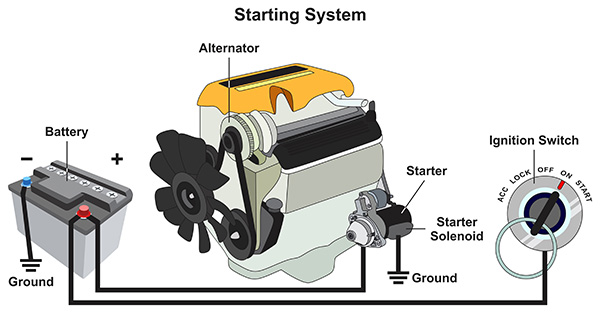
The starter motor uses a small gear to engage the larger ring gear attached to the engine. When you start the vehicle, that gear has to move into position cleanly, spin the engine, and then disengage once the engine starts.
If the starter drive is worn, sticking, or not moving far enough, the teeth can scrape instead of meshing correctly. That produces a sharp grinding sound right as you try to start the engine. A starter can still crank the engine despite early wear, so the fact that the vehicle starts does not automatically mean the starter is healthy.
Worn Flywheel or Flexplate Teeth Can Create the Same Sound
The starter gear has to mesh with teeth on the flywheel or flexplate. Those teeth can wear, chip, or break, especially if the starter has been grinding against them for a long time.
One useful clue is a grinding noise that happens only occasionally. The engine tends to stop in a few common positions, so damaged teeth in one section can cause noise only when the starter happens to engage that area. If the grinding changes from one start to the next, we inspect both the starter gear and the ring gear instead of automatically replacing the starter.
A Loose Starter Can Cause Poor Gear Alignment
The starter must be mounted securely and positioned correctly. If mounting bolts loosen or the starter shifts, the drive gear can enter the ring gear at the wrong angle.
That misalignment can create grinding even if the starter motor itself still has plenty of power. During an inspection, we check mounting hardware, starter position, and the condition of the mating surfaces. Replacing the starter without correcting a mounting problem can leave the new unit making the same noise.
A Weak Battery Can Contribute to Starter Engagement Problems
A weak battery usually causes slow cranking or clicking, but low voltage can also affect how the starter solenoid and drive mechanism operate. If the starter gear does not move into position firmly, engagement can be rough.
We check battery voltage and cable condition when a starting complaint is inconsistent. Corroded terminals, weak grounds, and damaged cables can reduce the voltage reaching the starter even when the battery itself tests reasonably well. The starting system works as a complete electrical circuit, so we don't ignore the power supply just because the noise sounds mechanical.
Grinding After the Engine Starts Points Somewhere Else
If the engine starts and then the grinding continues for a second or two, the starter may not be disengaging quickly enough. A sticking starter drive or solenoid can leave the small starter gear in contact with the flywheel after engine speed has already increased.
That can damage both the starter and ring gear very quickly. A different type of grinding after startup can come from a failing accessory bearing, A/C compressor, alternator, or pulley. Knowing exactly when the noise begins and ends helps us separate a starter problem from something driven by the engine.
Pay Attention to Other Starting Symptoms
Grinding is more useful diagnostically when we know what else happens at the same time. The engine may crank normally, hesitate before turning, or fail to move at all.
Clues worth noting include:
- Grinding only on the first start of the day
- Noise that happens randomly rather than every time
- A starter that spins without turning the engine
- Slow cranking along with grinding
- A single heavy click before the noise
- Grinding that continues after the engine fires
- A recent starter replacement
- Repeated starting problems getting worse over time
Those details can save time because they tell us whether to focus on electrical supply, starter engagement, mounting, or ring gear damage.
Do Not Keep Cranking Through a Grinding Noise
Repeatedly holding the key while the gears are grinding can turn a smaller starting-system problem into a much more expensive repair. Starter teeth can wear away, and damaged ring gear teeth can eventually prevent the engine from cranking at all.
Regular maintenance does not eliminate every starter failure, but checking battery condition, cable connections, and unusual starting noises can catch problems earlier. If the sound is getting louder or the engine occasionally fails to turn, it is better to diagnose it now than wait until the starter can no longer engage.
Get Starting System Service In Marietta, GA, With KLM Auto Center
If your vehicle grinds when starting, cranks inconsistently, or makes noise after the engine fires, KLM Auto Center can inspect the starter, battery, cables, mounting, and flywheel or flexplate teeth at its Marietta, GA locations.
Schedule a starting-system check before damaged starter or ring gear teeth leave the engine unable to crank.